The Group’s purpose “Unearthing unique possibilities”, is directly underpinned by three key priorities: extracting maximum value from operations, preparing for our future, and working responsibly and maintaining our social licence to operate.
Our social licence to operate depends on regular engagement with government and local communities, as well as financial and practical support, to address challenges with mutually beneficial and sustainable solutions. As responsible operators and social partners in our host countries, we endeavour to maintain healthy and constructive relationships with governments and our PACs.
As mining life is finite, we need to establish CSI projects that continue to create value in our absence.
Related sustainability principles
Select an icon to view principles
Prioritising environmental protection
Optimising socio-economic benefit
Prioritising the development and well-being of our employees
Related UN SDGs
We launched the first rolling three-year cycle to embed the UN SDGs into our systems, processes and decision-making during the year. The following UN SDGs relate to our social pillar:
US$0.2 million
invested in COVID-19 community relief (2020: US$0.1 million)
US$0.8 million
invested in social projects (2020: US$0.3 million)
US$164.9 million
spent on local procurement (2020: US$126.9 million)
Zero
major or significant community incidents (2020: zero)
Our goals
Supporting our PACs following localised flooding in 2021 that damaged infrastructure and washed away access roads.
Extending our support of existing CSI projects to ensure their independence and sustainability following the impact of COVID-19.
Reducing costs and enhancing operational efficiencies while balancing the needs of our stakeholders.
Working to implement both the 2021 CSI strategy and projects postponed from 2020 resulting from the COVID-19 related lockdowns and restrictions.
Our future
Strengthen our partnership with our PACs through CSI initiatives that support the creation of lasting mutually beneficial industries, through extended support.
Enhance communication and stakeholder engagement.
Mature our integration of UN SDGs into our corporate social responsibility strategy.
Material matters
Our context
Since the start of the COVID-19 pandemic, our primary objective has at all times been to operate safely and responsibly, ensuring the safety and health of our workforce, their families and the communities surrounding our operations while also supporting Lesotho’s national effort to curb the spread of the virus.
At Letšeng, 98% of our workforce resides in Lesotho, and therefore we recognise that embedding a safe and responsible workplace practice at Letšeng directly and indirectly benefits and protects vulnerable PACs. Our mining operations face daily challenges due to their remote locations, including extreme weather, difficult transport routes and limited public infrastructure. While these circumstances pose significant operational challenges, they can also impact the health and well-being of the communities surrounding our operations. In addition to the challenges community members face due to their natural and built environment, our responsibility as a good corporate citizen is to protect our communities against any potential risks posed by our mining operations and support our communities during times of crisis.
Our TSFs are integral to mining operations, yet they present a substantial risk if not responsibly managed. In response to global TSF failure-events, the ICMM developed and finalised the GISTM for its member companies. Gem Diamonds has adopted the GISTM and aligned its existing TSF Code of Practice with the recommendations of the Standard.
Our approach
We follow a comprehensive social and environmental engagement programme to help us identify the need of PACs. The Letšeng operation has committed to investing 1% of annual turnover or a minimum of LSL5 million towards community initiatives every year. In addition, following the recovery and sale of special diamonds, those greater than 300 carats, 1% of the diamond’s sale value is directed to social projects. These commitments are included in our Mining Lease agreement with the Government of Lesotho.
During 2021, Letšeng engaged an external independent party to conduct a needs analysis within the Mokhotlong and Thaba-Tseka districts. The findings of the needs analysis informed the five-year community investment strategy, ensuring that the identified community needs directly inform the CSI strategy.
COVID-19
We leverage our infectious disease management platform to help raise awareness about COVID-19 by engaging extensively with government, medical experts and communities. The goal is to protect our workforce and support Lesotho locally and nationally in minimising the impact of the pandemic.
We continue to support the Lesotho government in its fight against COVID-19, and in 2021 Letšeng donated 20 000 vaccines, oxygen concentrators, personal protective equipment and an ambulance. Approximately 99% of our Letšeng workforce have been vaccinated.
Dam safety and integrity
Globally, the most recent dam failures are attributed to ‘upstream’ construction methods. Letšeng has three dams on site: the Patiseng TSF, the Old TSF and the freshwater Mothusi Dam – all constructed using 'centre line and downstream construction methods, which is recognised as a safe and stable construction method'. Gem Diamonds prioritises the safe and responsible management of its tailings and freshwater storage facilities to mitigate any potentially significant risk posed by these facilities.
The Letšeng facilities undergo stringent daily, weekly and monthly inspections during which various factors are surveyed, including water level, beach length, freeboard and overall structural stability. Furthermore, we have implemented an early-warning system with continuous community training and awareness programmes to ensure communities' emergency readiness in the unlikely event of a failure. Ensuring the integrity of our mining waste and freshwater storage facilities also safeguards our communities. We are proactive in monitoring dam safety in terms of our GISTM aligned Dam Safety Protocol. Stringent dam wall safety monitoring involves regular internal and external inspections and audits throughout the year. The findings and recommendations are reported to the sustainability subcommittees and the Board. For more information about our TSFs, please read the Gem Diamonds voluntary disclosure as part of the Investor Mining and Tailings Safety Initiative of the Church of England.
We also regularly monitor natural springs and local boreholes in and around our PACs. Over the years, we have seen an increase of E.coli bacteria from livestock fouling the community water sources while grazing or drinking. To assist the communities and mitigate the risk of bacterial infection from the E.coli we provide clean potable water to local communities.
Road safety
As basic transport infrastructure and road services in the region and communities surrounding Letšeng is inadequate, we regularly upgrade roads, clear snow, scatter salt on iced access roads and remove vehicles obstructing access to communities and the mine. In the event of vehicle accidents and other road emergencies, the Letšeng clinic and healthcare workers, which include advanced life support paramedics, are often the closest and best equipped to assist. In 2021, the clinic responded to 13 accidents on national roads and 60 injured people from the public were treated in our clinic.
Our performance
Zero incidents of compromised dam integrity were recorded in 2021 (2020: zero).
In 2021, the Letšeng emergency team responded to 22 emergency calls (2020: 12) from PACs of which 13 were motor vehicle-related (2020: 9).
Our context
The strength of our relationships with our stakeholders, particularly employees, regulators, PACs and host governments ensure our social licence to operate. These relationships depend on our effective management of ethics, labour practices, environmental and social responsibility, and our risk management and engagement activities with stakeholders. Our culture of care encourages us to engage, listen and respond responsibly to our stakeholders' needs. Our decision-making is helped by regular stakeholder engagements, enabling us to create value for society at large and promote our long-term sustainability. Refer to our Annual Report and Accounts 2021for more information about stakeholder engagement and management.
As Lesotho has high levels of unemployment, inequality and poverty, we have a responsibility to contribute positively and sustainably to the economy and to our PACs during and beyond life of mine. Letšeng is guided by our stakeholder engagement and corporate social investment strategy in this regard. For more information, refer to our case study on community engagement and impact.
Our approach
Our community engagement approach is informed by operation-specific social and environmental impact assessments (SEIAs) and community needs analyses following extensive public participation. It is also aligned with host country legislation and international best practice guidelines such as the Equator Principles and the International Finance Corporation (IFC) Performance Standards on Environmental and Social Sustainability.
Acknowledging our communities' unique cultural and traditional context is essential, and we aim to engage transparently and respectfully. We achieve this by employing suitably qualified and trained people. Furthermore, our operations have a stakeholder consultation framework to ensure regular, meaningful engagement. We integrate feedback from these engagements in our decision-making. At Letšeng, community representatives communicate with the CSI department as a sustainable and culturally effective link between PACs and the mine. Community representatives sit on the CSI subcommittee of the Letšeng Board, which meets quarterly to discuss the implementation and sustainability of current and planned projects.
Community engagement at Ghaghoo was downscaled when the mine was placed on care and maintenance in 2017. Although this reduced CSI project-related investment at Ghaghoo, we continue to support the Gope community close to the mine with potable water, medical care and inclusion in regular health and safety campaigns.
Our performance
No major or significant stakeholder incidents occurred at any of our operations (2020: none).
No incidents involving any violation of the rights of the indigenous people on whose land the Group operates (2020: none).
COVID-19-related aid and assistance provided to PACs.
20 000 vaccines donated to the Government of Lesotho.
US$0.9 invested to minimise the impact of the COVID-19 pandemic in Lesotho.
Our context
As our mines are in remote rural locations, we recognise and respect the importance of protecting the surrounding communities' well-established cultures and social structures. We believe it is our duty to support the upliftment of these communities' economic, environmental and social sustainability potential, promoting practices that protect human rights in every aspect of our operations.
Our approach
Our six identified SDGs are integrated into our community investment strategy to ensure that projects contribute to both local needs, and global goals.
Our overarching impact assessments are guided by Free, Prior and Informed Consent (FPIC) guidelines. FPIC is a specific right that pertains to indigenous peoples and is recognised in the United Nations Declaration on the Rights of Indigenous Peoples (UNDRIP). It allows them to give or withhold consent to a project that may affect them or their territories.
We align our community engagements and CSI projects with international best practice and sustainability principles. Our informed approach uses information gathered in community needs analyses and SEIAs. These assessments include extensive public participation to understand our PACs’ needs and concerns. The goal is to minimise adverse mining impacts while identifying opportunities for positive outcomes. Our SEIAs involve biodiversity surveys as well as studies of soil, water and air quality, archaeological surveys, visual and socio-economic impact assessments, and an extensive public participation process.
Our performance
Zero incidents involving the violation of the rights of indigenous communities (2020: zero)
We continued to engage with PACs through established and enhanced forums in a safe and responsible manner
Zero major or significant community grievances were lodged (2020: zero).
Our context
Lesotho is a developing country with high poverty rates. The three districts bordering our Letšeng mine are home to some of the most impoverished communities in Lesotho. The diamond and textile industries are the primary contributors to the country’s export economy. We contribute towards our host communities through the payment of taxes and royalties as well as our sustainable development investments, local employment and procurement practices. To ensure that our investments create meaningful change, we focus on authentic engagement with our communities to understand their needs and implement sustainable projects.
Our approach
We value our mutually beneficial relationships with our PACs as this ensures our long-term sustainability. We comply with regulations and legal requirements, and go beyond legislation to make a meaningful impact and meet our host communities' needs.
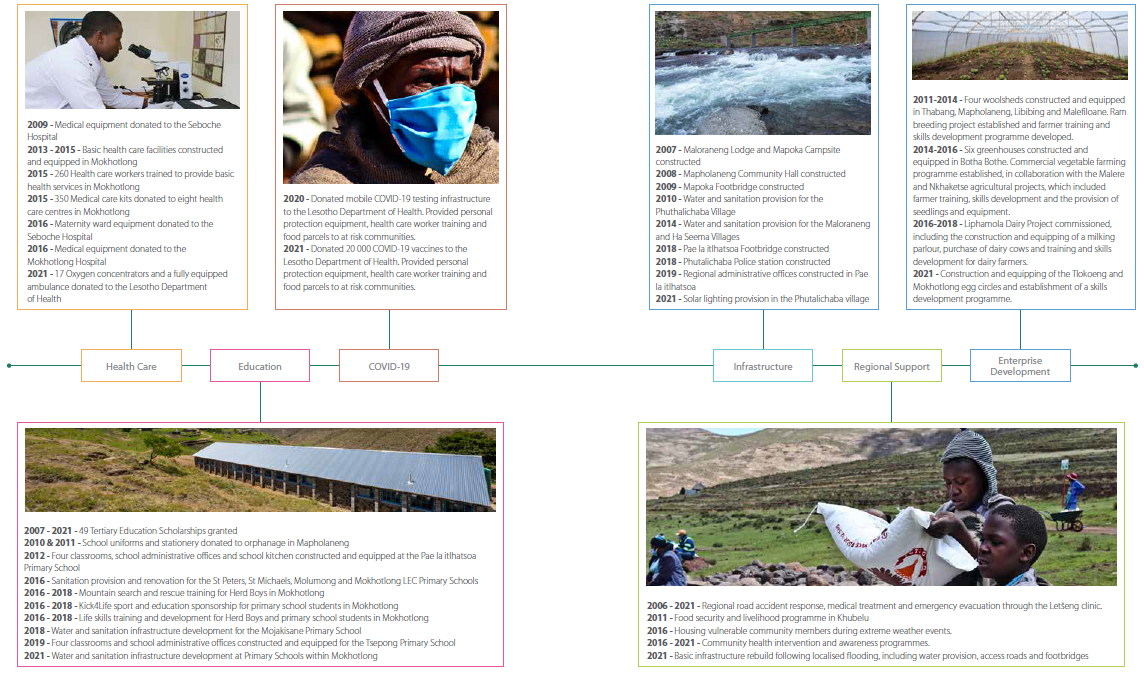
Each project in our CSI programme follows a five-year plan to ensure sustainability. Our CSI projects focus on education, health, infrastructure, the environment and enterprise development. We include the SDGs in conceptualising new CSI initiatives to contribute to achieving these goals. Refer to our Annual Report and Accounts 2021 and Our Approach to Climate Change report for more information.
We also value education, mentorship and skills transfer. Our scholarship programme works with the government to identify scarce skills, particularly in mining, engineering, emergency medical care, geology and finance. Since the scholarship programme was launched in 2006, 48 scholarships have been awarded to deserving young Basotho, 47 of whom have graduated successfully and 25 of whom are employed full-time at the mine.
Our corporate social investment in Lesotho
Our performance
CSI investment of US$0.8 million (2020: US$0.3 million).
Externally led community Needs Analysis.
The Tlokoeng and Mokhotlong egg circles were completed at the end of October, farmers subsequently began supplying eggs to the Letšeng mine.
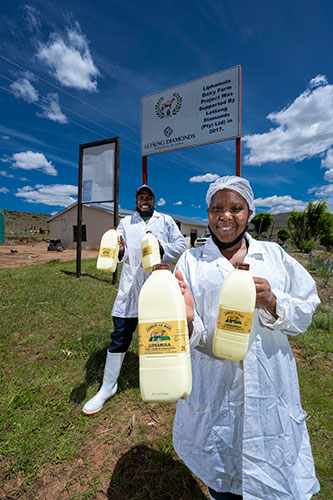
We provided ongoing support to our flagship dairy and vegetable projects when handover was delayed due to the COVID-19 pandemic.
Since its inception, we have issued 48 scholarships and over 100 interns have received valuable experience at Letšeng mine.
Our context
Localisation is crucial in creating shared value for our host countries and communities. We therefore employ people from our PACs and engage with local businesses in our supply chain to contribute meaningfully to the well-being of our communities while meeting our business needs.
Our approach
The Letšeng mine is a major contributor to Lesotho’s economy, providing jobs for more than 1 600 people and supporting socio-economic development through focused local procurement initiatives.
We recruit locally and match available local skills with our operational requirements wherever possible. In total, 98% of our Group’s workforce are citizens of our host countries.
We also ensure that our goods and services are purchased from local suppliers who comply with necessary standards, and we help these entrepreneurs develop their businesses.
Our performance
98% of Letšeng’s workforce comprises Lesotho nationals (2020: 98%).
Group in-country procurement was US$164.9 million (2020: US$126.9 million) of which US$3.4 million was procured directly from PACs (2020: US$2.2 million) and US$31.4 million (2020: US$27.4 million) from communities around Letšeng.