Our commitment to responsible environmental stewardship and the UN SDGs compels us to better understand and manage our impact on the natural environment, mitigating climate change and other environmental risks, so that we leave a positive legacy for future generations.
Related sustainability principles
Select an icon to view principles
Improving resource use efficiencies
Prioritising environmental protection
Optimising socio-economic benefit
Related UN SDGs
We launched the first rolling three-year cycle to embed the UN SDGs into our systems, processes and decision-making during the year. The following UN SDGs relate to our environmental pillar:
In 2020, operations were suspended at Letšeng from 28 March to 26 April due to the Lesotho Government’s COVID-19 related lockdown. Operational activities were ramped up during May and planned waste mining activities was successfully deferred to resume in July. This suspension of operations explains the reduced resource consumption during 2020. For comparative purposes we have provided both 2019 and 2020 resource consumption data.
Zeromajor environmental incidents
for the 13th consecutive year
US$14.9 million
environmental rehabilitation provision (2020: US$16.1 million)
Annual social and environmental management plan (SEMP) audit programme implemented
8.9 million m3
of water recycled. (2020: 8.8 million m3, 2019: 7.9 million m3).
Zerosignificant environmental incidents for the 8th consecutive year
Nofines for environmental transgressions or non-compliance with host country legislation for the 12th consecutive year
ISO 14001
accreditation retained
Total carbon footprint of 153 864 tCo2e (2020: 135 694 tCo2e, 2019: 172 968 tCo2e)
US$0.9 million
invested in environmental protection during 2021 (2020: US$0.5 million)
ICMM Global Industry Standard for Tailings Management adopted and dam safety management framework implemented
Rehabilitation and closure
management strategy adopted and updated
US$0.2 million
invested towards adopting the recommendations of the TCFD
Our goals
Understanding the long-term implications of climate change on our operations.
Identifying further opportunities to decarbonise our operational activities.
Managing the effects of extreme weather on our operations.
Reducing consumption, particularly of fossil fuels, remains a focus as we identify
and evaluate renewable energy solutions.
Implement innovative waste management strategies taking into consideration
the remote location of our operations and limited formal waste disposal facilities within our host countries.
Prioritising water conservation throughout the Group.
Our future
We remain committed to environmental responsibility, including rigorous and ongoing monitoring of our water management, reducing our environmental footprint, the recommendations of the TCFD and upholding our commitment to the UN SDGs.
In 2022, we will advance our TCFD roadmap to appropriately respond to relevant climate change-related risks and opportunities. We will review our operation-specific SEMPs for improved impact mitigation, implement our concurrent rehabilitation plan at Letšeng and aim to develop and implement carbon, water and waste management initiatives while maintaining and improving environmental standards.
Material matters
Our context
We strive to responsibly manage our environmental impacts by measuring, monitoring and minimising our consumption, considering our water and carbon footprints and waste within our value chain. We ensure responsible consumption with the utmost respect for the natural resources we need.
We are working with operations to identify initiatives that reduce our costs, resource consumption and our carbon, energy and water footprints. These initiatives are predominantly focused on scope 1 and scope 2 carbon emissions, being (mobile and stationary fuel combustion and grid electricity), as these represent approximately 84% of the Group’s total carbon footprint.
In addition, we understand that responsible waste management plays a significant role in the sustainability of our business and long-term protection of our environment. Our operation, which mainly generates waste rock and residues from production processes, ensures responsible management and disposal of all mineral and non-mineral wastes.
Our approach
Carbon
We understand that it is a global imperative to reduce our carbon footprint. Our goal is to reduce our carbon emissions to avoid any dangerous anthropogenic interference in our climate system. Our decarbonisation strategy considers all stakeholders and will be implemented in a way that maintains our goal of mining in a responsible manner. Letšeng operates in a country without wide-scale access to renewables, as such a flexible and innovative approach to decarbonisation is required.
Our carbon footprint is monitored and measured bi-annually to develop and implement initiatives that mitigate our environmental impact.
Water
Our operations are reliant on the continuous supply of water. We collect rainwater in our freshwater and process water storage facilities for operations and consumption on site. We are mindful of our valuable relationship with our PACs, especially regarding access to sufficient potable water, food security and stakeholder engagements. We know that we cannot secure water resources for our mine without ensuring that the water requirements of our PACs are met. Our Group water management policy considers the water needs of all stakeholders. Various operational departments have implemented initiatives to reduce process water consumption, secure adequate water reserves to operate during potential future drought conditions and ensure stable access to water for PACs.
The water catchment facility below our Patiseng TSF captures seepage and recycles water back into our processing plants. This reduces the use of freshwater for processing and to prevents nitrates, related to the use of explosives, from entering the natural environment. We have also created a wetland in our Qa Qa catchment with endemic plants that absorb nitrates and purify run-off during the summer months. The Group successfully completed its bioremediation pilot plant study during 2021, with plans to construct a full-scale-bioremediation plant in our RTZ catchment during 2022. Bioremediation uses naturally occurring micro-organisms within the soil to absorb nitrates from water, refer to our Managing our impacts through bioremediation case study.
Waste
We continually seek ways to improve our waste reduction efforts to minimise our impact on the natural environment and surrounding communities. Our mining operations have waste management plans for effective waste handling.
Non-mineral waste generated at our operations is managed in line with the waste hierarchy: reduce, reuse, recycle and, as, last option, dispose. During 2021, we focused on reducing three main sources of waste – food, plastic and polystyrene waste.
To minimise food waste as much as possible, the catering and environmental teams identified and implemented initiatives to reduce the volumes of food waste.
In addition, to more effectively manage food waste, Letšeng purchased a food shredder that ensures improved composting and fermentation rates of the waste. The compost and compost tea (a product of the fermentation process) is used to bolster rehabilitation trials and concurrent rehabilitation projects.
The Letšeng operation also ran campaigns focused on reducing plastic waste, which included a total ban on bringing plastic to site during November. It also aligned with a national initiative “Plastic Free Wednesdays” during 2021. Staff were provided with reusable lunchboxes to replace single use containers for food storage. We continue to look at introducing sustainable initiatives to reduce plastic use and waste in 2022.
The operations are compliant with the Basel Convention on the Control of Transboundary Movement of Hazardous waste and ensure that relevant permits are in place when hazardous waste is moved from Lesotho to South Africa, as there are currently no hazardous waste disposal sites in Lesotho. Hazardous waste is then responsibly disposed of in South Africa at certified sites, that issue safe-disposal certificates.
Mineral waste at Letšeng is retained on-site in structures designed for this purpose. These structures comply with Lesotho's requirements and international best practice standards. Our non-mining operations generate small quantities of domestic waste. During 2021 we advanced our adoption of the ICMM Global Industry Standard on Tailings Management. Appropriate governance committees were established to oversee the adoption and alignment of operational practice with the standard, including the constitution of an internal tailings review board consisting of two world renowned tailings facility and risk management experts.
Operationally we continue to look at ways to minimise the mining and movement of mineral waste. Our steeper slope project has significantly reduced the mining and movement of mineral waste, and further opportunities in this regard are being explored.
Our performance
Carbon
At Letšeng, we have implemented numerous initiatives reducing our carbon emissions, such as steepening the slope of the pit walls to reduce waste movement and shortening our waste hauling distances by optimising our routes. These initiatives reduce our carbon emissions through reduced fuel consumption. Refer to our Annual Report and Accounts 2021 and Our Approach to Climate Change Report for our carbon emissions performance metrics.
Water
We actively minimise freshwater use by recycling and reusing water on-site, recovering run-off water, managing the impact and flow of stormwater, and economising our water consumption. Our stormwater management system is designed to catch and redirect stormwater drainage into our freshwater dam and we continually explore additional catchment and freshwater supply opportunities for the operation and its PACs. Refer to Annual Report and Accounts 2021 and Our Approach to Climate Change Report for our water consumption performance metrics.
Waste
Effective waste management and awareness campaigns continued, and a food waste shredder and an incinerator were installed and commissioned during the year at Letšeng to improve waste management.
Our context
It is widely accepted that human influence has warmed the atmosphere, ocean and land, causing widespread rapid changes to the planet and the climate system as a whole. Human-induced climate change has already affected weather patterns across the globe. The International Panel on Climate Change (IPCC) Working Group 1 predicts that the world will exceed a 1.5℃ global temperature increase within the next two decades.
Our operations are located in remote areas, making them susceptible to more frequent extreme weather events due to climate change. These weather events include snowstorms, extreme temperatures, flash floods and drought. Understanding climate-related risks and potential impacts is key to assess our organisational exposure and resilience to climate change. It also provides guidance to update business continuity plans and operational strategies to mitigate the impact of climate change-related risks.
Historical natural events in Lesotho include hailstorms, snowstorms, droughts and frost days. The longest drought in over 200 years was recorded between 1991 and 1995, which negatively impacted communities and the economy within Lesotho.
Lesotho frequently experiences localised floods, damaging basic service infrastructure in already impoverished communities, with 75% of the Lesotho population residing in rural areas, and are exposed to the effects of extreme weather including extreme cold, snow and other precipitation events.
Our approach
We are cognisant of the risks presented by climate change and its potential impact on our operations and stakeholders. This year, we adopted the TCFD framework and implemented its recommendations throughout the Group.
We view climate change through two lenses, in line with the framework's recommendations. Firstly, we ensure operational resilience and continuity in terms of the physical risks, including extreme weather events. Secondly, we are preparing for the transition to a low-carbon economy.
Our TCFD roadmap, which will guide our implementation over the next three years, was approved in 2021 by the Board.
Phase 1 (2021)
Phase 2 (2022)
Phase 3 (2023)
Build the foundations to support meaningful science-based decision-making
Understand the risks we face and reflect on our organisational resilience
Establish clear metrics and targets for monitoring and managing our exposure
During 2021 the Group undertook a climate change scenario analysis (CCSA) to assess which physical climate change-related risks will emerge at our locations over the short-, medium-and long-term. The CCSA was based on a mix of quantitative and qualitative data and information sourced from the Carbon Brief and World Bank climate change knowledge portal. This data and information informed the short-, medium- and long-term models developed for all locations in which the Group operates in.
The CCSA especially focused on Letšeng, currently our only operating mine. It also took into consideration the life of mine of the operation.
Four temperature increase scenarios were included in the CCSA, namely 1.4℃, 1.9℃, 3.3℃, and 6.0℃. These scenarios were informed by shared socio-economic pathways (SSPs). The SSPs were developed by climate scientists to model the greenhouse gas concentration trajectory, and was subsequently adopted by the IPCC. The 6.0℃ scenario represents the current world economy continuing to function under the current conditions of little to no climate adaption or global GHG emissions reduction initiatives.
The physical weather parameters considered in the modelling included:
Temperature
Wind
Frost days
Heat days
Cold waves
Heat waves
Precipitation events
Drought likelihood.
The risk to the Group, in terms of potential physical climate impact, was assessed considering the following aspects:
Human health
Water resource availability
Energy and electricity
Vegetation.
The CCSA identified the following physical climate change-related risks that could impact on the Letšeng operation:
Temperatures will increase over the next two decades
The number of frost days at the operation will increase
The operation will, on average, experience reduced precipitation and more frequent severe drought periods
Sporadic occurrences of thunderstorms and hailstorms will be more extreme.
The above physical climate change-related risks will inform an operational exposure assessment to drive the Group adaptation and mitigation strategy.
The last three years have seen an acceleration of climate change-related information and regulations. The Group has embraced these and is actively incorporating them into relevant climate change strategies and plans such as the Letšeng climate change adaptation and water management plans. These updates will also include the specific physical climate change-related risks identified through the CCSA.
The Group has its two assets located in extreme natural environments and it has been managing and responding to extreme natural events since 2006. The operational business continuity plans, disaster management plans, and all other operational procedures and systems, are informed by the extreme weather already experienced at these locations. The Letšeng operation maintains a two-week supply of food and diesel, should extreme weather disrupt access and energy supply. In addition, our medical teams are suitably equipped with extensive training in high-altitude rescues and treatment under extreme conditions.
Our water management systems also consider potential natural events. Dams and storage facilities are managed so that there is excess capacity to handle a sudden influx of water without compromising safety.
We adopted the TCFD recommendations and implemented phase one of our three-phase TCFD roadmap. The implementation of phase one included:
Improved climate change governance structures
Enhanced organisational risk processes to overtly integrate climate change
Completion of a detailed climate scenario analysis to ensure science-based data informs decisions
Appropriate training to ensure understanding of climate change across the business
A strategy process which integrates climate change considerations
Updating the climate change adaptation plan.
Updating the stormwater management and catchment plan
Our context
The consistent and stable supply of power is critical for mining operations. The Letšeng mining operation accounts for the vast majority of the Group's energy consumption, both in terms of fossil fuel-based energy and grid-based electricity. Therefore, our energy efficiency initiatives are focused on reducing the energy consumption profile at Letšeng. Our one direct source of grid electricity at the mine is grid-based electricity through the Lesotho national grid, which is fed through the South African national electricity supplier Eskom. Grid instability and rotational loadshedding by Eskom affects the Letšeng operation as the electricity supply to Lesotho is cut periodically to protect the South African national grid.
To ensure a consistent supply of energy to the mining operations and associated infrastructure, a generator-based power supply system is in place. The generators are operated when extreme weather or Eskom-related electricity cuts impact production.
The Ghaghoo mine, which is currently on care and maintenance, is powered by an on-site generator as no access to grid-based electricity exists at that location. The Group's office-based locations are all fed through grid electricity.
Our approach
As part of the work that the Group is doing to reduce its carbon emissions, we have identified several opportunities relating to energy and electricity that will assist us as we strive to decarbonise the business and evaluate which opportunities are feasible for the Group to implement. The Group recognises the need to transition appropriately to energy sources that are less carbon intensive than the traditional fossil fuel-based energy sources that currently power our operations.
During 2021, the Group assessed several energy-saving initiatives, specifically at Letšeng as the primary energy consumer. Our approach to energy saving initiatives considers both short- and long-term initiatives. The following initiatives were implemented in 2021.
By optimising heating systems, we were able to reduce the energy requirements for accommodation heating by 19%.
Through the implementation of technology that staggers energy demand related to lighting and water heating, we reduced the peak power demand in the accommodation facilities by 28%.
The Letšeng operation implemented a ISO 50001 aligned energy management system that further informs the operational approach to manage, track and protect energy supply as well as track and minimise energy consumption.
We reduced our waste rock hauling distance, resulting in a reduction of our carbon emissions and diesel consumption. See Unlocking value through collaboration case study
The Group commissioned independent energy advisers to identify opportunities to improve energy efficiency and reduce energy-related emissions as a result of reduced consumption or cleaner energy sources. The assessment included mobile and stationary combustion-related fossil fuel consumption and grid-supplied electricity.
The various studies undertaken during 2021 also identified a number of challenges that the Group needs to consider in its decarbonisation assessments:
The remaining life of open pit mine at Letšeng impacts on the feasibility of any capital-intensive projects.
The mine operates in a region that is protected as a nesting zone for endangered vultures, as a result, wind power development is not possible within a 40km radius of the operation.
The location specific irradiance of the Letšeng mine indicates that a maximum of 5.5 hours a day is available for energy yield through solar PV.
The extreme low temperatures at Letšeng eliminates the possibility of Biodiesel replacing or substituting traditional mineral diesel due to the biodiesel thickening within the fuel system at low temperatures.
As of 2021, no renewable or alternative electricity sources are available to Letšeng to replace the existing grid supplied electricity supply.
At Ghaghoo, energy consumption has reduced since the operation was placed under care and maintenance in 2017 with further reductions in 2020 and 2021 following the reduction of our underground dewatering activities. One generator remains in use for essential services and there is a back-up generator when needed.
Our performance
Frequent loadshedding and extreme storm events have increased the use of generators at Letšeng. These energy interruptions are potentially damaging and costly as machinery must shut down safely and not mid-use. Restarting machinery also consumes more power and could damage equipment. Power interruptions therefore pose a risk to our operations. To mitigate this risk, we ensure that loadshedding schedules and regional weather predictions reports are integrated into our production planning to facilitate an effective change-over to generator power.
Mining is one of the main contributors to the gross domestic product (GDP) of the countries in which we operate. It offers considerable direct and indirect employment opportunities during a mine's lifespan. However, there is potential for adverse environmental and socio-economic impacts if mines are not managed responsibly during and post its lifespan. Rehabilitating the environmental impact only is not sufficient to responsibly close a mine, and our mine closure plans therefore also consider the socio-economic status and impacts of potential mine closure on our PACs.
Our approach
We take a long-term view of the land under our management, recognising that adverse impacts must be remediated to demonstrate responsible stewardship of natural resources. All our project life cycles focus on the rehabilitation of our mine lease areas, during and post life of mine.
We follow best practice when planning mine-closure programmes. This is part of our responsibility to our host countries and the communities close to our mines. Our operations have integrated rehabilitation plans that are supported through concurrent rehabilitation and annual reassessment of rehabilitation strategies. This approach ensures that we meet our closure objectives as responsibly and efficiently as possible. We also quantify unforeseen mine rehabilitation and restoration costs, and make adequate financial provision in the Group's financial statements.
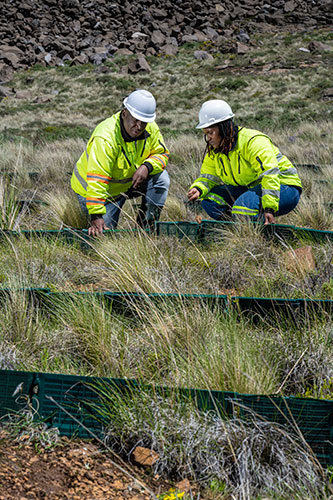
As Letšeng is located in the extreme highlands of Lesotho, guidance on successful rehabilitation is scarce. Since 2012, a series of trials have examined different rehabilitation applications to test closure criteria and estimate the mine's rehabilitation and closure costs. These trials replicate the rehabilitation of the mine's main waste residue disposal facilities: fine tailings (slimes), coarse tailings and waste rock. The trials use waste rock and tailings reserves with minimal topsoil requirements, and examine vegetation rehabilitation and restoration of natural ecosystems. Topsoil is essential for successful vegetation and it is considered a critical component to the successful post-mining rehabilitation of the mine.
In addition to these initiatives, several academic studies are underway, in collaboration with the National University of Lesotho and North-West University in South Africa, at Letšeng to inform rehabilitation and support mining strategies and techniques that enable concurrent rehabilitation.
Our Ghaghoo mine remains under care and maintenance. We continue to review its rehabilitation plans as we investigate restorative initiatives to reduce the end of mine life liability.
We engage with independent experts at Letšeng and Ghaghoo to understand the work needed to ensure safe and responsible end of life mine closure. The Group's rehabilitation plans and resultant liability are reviewed every year. In 2021, the end of mine life rehabilitation provision reduced to US$14.9 million (2020: US$16.1 million) following improved concurrent rehabilitation planning.
Our performance
US$14.9 million environmental rehabilitation provision (2020: US$16.1 million) with the decrease attributable to the updated concurrent rehabilitation strategy
6 174ha of land under our management (2020: 6 174ha)
1.95ha newly disturbed land by mining operations (2020: 10.2ha)
Total disturbed land to 776.15ha (2020: 774.2ha)
Rehabilitation plans were updated
Rehabilitation and revegetation trials at Letšeng are proving successful.
Our context
While mining is a significant contributor to host nations' socio-economic prosperity, it can also have a significant environmental impact. Gem Diamonds is committed to mitigating environmental damage, protecting biodiversity and enhancing conservation efforts.
Letšeng is located in the Maluti Drakensberg Transboundary Park, a legally protected key biodiversity area. All potential biodiversity impacts of the mining activities were assessed as part of the SEIA process and the SEMPs include consideration for the management and mitigation of direct, indirect and cumulative impacts. Operational Biodiversity Management Plans have been developed for Letšeng and are reviewed annually. Biodiversity monitoring is conducted every two years to inform further possible updates to our management plans.
Our approach
We are responsible for protecting the biodiversity of indigenous flora and faua surrounding our mine. Through our closure planning, rehabilitation strategy and biodiversity management plans, we ensure biodiversity is included in our financial planning and long-term strategy objectives.
We collaborate extensively with our host countries, PACs, regulators, scientists and other industry stakeholders to implement practical environmental protection strategies. Ultimately, we aim to ensure environmental and socio-economic sustainability and prosperity for our host countries, PACs and business. Bioremediation is the cornerstone of our water quality conservation efforts and a critical part of our stakeholder relationships.
Our biodiversity risk assessments take into consideration all threatened, migratory and endemic species as well as regionally relevant ecosystem services such as rangeland, wetlands, grassland and water. At Letšeng, the biodiversity offset strategy has been implemented to mitigate mining-related impacts on biodiversity. The offset strategy includes:
No-go areas, protected from any development.
An indigenous plant garden.
An artificial wetland construction programme.
Native seed propagation and rehabilitation trial programme.
Concurrent rehabilitation plan.
Grazing management plan in collaboration with subsistence farmers in the region.
Our annual biodiversity monitoring found positive rangeland performance over the 2020-2021 period and increased biomass production in the mine lease area as a result of biodiversity initiatives. The spiral aloe (Aloe polyphylla) is a protected plant that is endemic to Lesotho and threatened to near extinction. Despite being declared a protected plant in Lesotho since 1938, their in-country numbers have been declining.
During 2021, the Letšeng biodiversity monitoring noted a high density of both adult (894) and seedling (70) spiral aloes, and no indication of illegal harvesting on-site. The successful establishment of the spiral aloe is indicative of the successful biodiversity management strategy implemented at the operation. In addition, the monitoring also confirmed that the mammalian diversity on-site has remained stable for the 2015-2021 period. Letšeng hosts 39.5% of all mammalian species found in Lesotho.
Our performance
Conservation plans updated annually.
Biannual mammal-monitoring protocol rolled out.
Completed a wetland rehabilitation and biodiversity offset project.